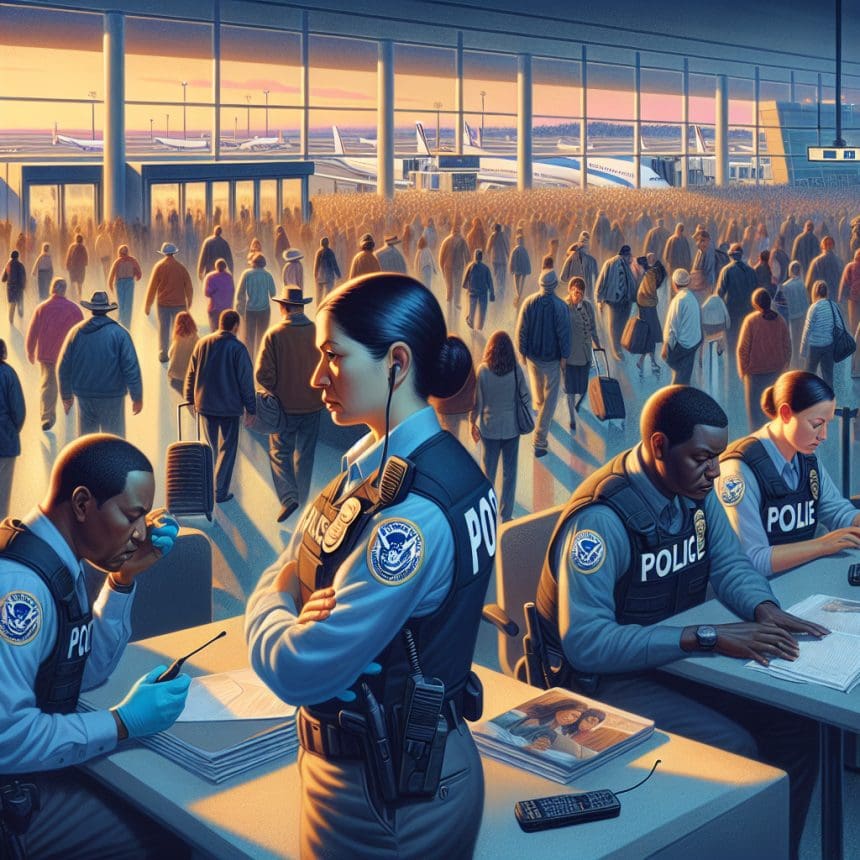
Headline: ICE Agents Assist at Airports as Security Staffing Woes Grow
In response to escalating security staff shortages, federal ICE agents have begun patrolling select U.S. airports to bolster security measures. This initiative, launched earlier this week, aims to enhance passenger safety and ensure compliance with immigration laws at major transportation hubs across the nation. The decision comes amid reports of difficulties in staffing and maintaining adequate security personnel levels, prompting federal authorities to act.
As the busy travel season approaches, U.S. airports have faced mounting challenges related to staff shortages in transportation security. The Transportation Security Administration (TSA) has been struggling to keep pace with renewed passenger levels following the COVID-19 pandemic, leading to increased wait times at security checkpoints and heightened concerns about airport safety. The TSA’s hiring initiatives have not yet filled the gaps left by departing staff, leading to a strain on resources at airports nationwide.
In light of these challenges, the Department of Homeland Security (DHS) has authorized the deployment of ICE agents to assist local authorities in ensuring a secure travel environment. This decision underscores the government’s commitment to maintaining safety at critical transportation fixtures while simultaneously addressing staffing constraints faced by airport security personnel.

The ICE agents, who typically focus on immigration enforcement and preventing illegal activity, will now also serve as a presence in public areas of airports. Their roles will include monitoring passenger movements, providing additional support at security checkpoints, and assisting TSA agents as needed. According to DHS spokespersons, this dual function aims to leverage ICE’s capabilities while alleviating some pressures on the TSA.
While this deployment has garnered support from various factions who believe it provides much-needed security reinforcement, it has also raised concerns among civil liberties advocates. Critics argue that the presence of federal immigration enforcement agents could deter lawful travelers and potentially escalate tensions, particularly among immigrant communities who may feel scrutinized at airports.
Airport authorities have emphasized that the agents will focus strictly on enhancing security without interfering in the normal travel process for passengers. However, the potential impact on traveler sentiment cannot be overlooked as the nation gears up for summer travel peak times.
TSA Administrator David Pekoske stated, “The collaboration between TSA and ICE is crucial at this juncture. We want to ensure that all travelers can enjoy a safe and secure airport experience without any delays.” He underscored the need for immediate relief given the impending busy travel season and ongoing remodeling of existing security measures.
The situation at major airports is compounded by increased post-pandemic travel, which has more than doubled in recent months. International flight resumes and domestic travel rebounding have exacerbated the strain on security staffing. Increased passenger flow thus threatens to amplify wait times and airport congestion, leading officials to consider unconventional support strategies, such as the deployment of ICE personnel.
Moreover, hiring in the TSA has become challenging owing to competitive job markets and federal hiring policies. Many airports report difficulties attracting qualified candidates which in turn exacerbates staffing gaps that are critical when facing travel surges. The TSA is actively exploring incentives to recruit and retain staff, but these long-term strategies take time and immediate action is desperately needed.
The proactive steps taken by federal authorities illustrate their critical balancing act between enforcing immigration policies and ensuring safety in public transport. With the recent decision, oversight agencies are monitoring patron sentiment as well as operational efficiency.
As ICE agents become a visible part of the air travel landscape, their impact will be closely observed. The government’s move signals that maintaining airport security is a top priority, but how this is received by the public will play a crucial role in shaping future security strategies.
Critics of the initiative call attention to the necessity of holistic solutions that do not compromise civil liberties while enhancing security arrangements. Groups advocating for passenger rights stress that transparent communication between authorities and travelers is vital to allay fears and foster a safer airport atmosphere.
With the summer months approaching, and international travel increasing day by day, the attention on the intersection of immigration enforcement and airport security is timely. Whether the partnership between TSA and ICE proves effective in alleviating current staffing challenges remains an open question.
As this story develops, it will be pivotal for federal agencies to listen to community feedback and adapt practices to ensure that airports remain venues of safe and secure travel for all U.S. residents and visitors alike.
In the coming weeks, airport authorities and federal agencies are advised to keep monitoring the effectiveness of this collaboration and assess any operational adjustments necessary to mitigate the impact on traveler experiences. The unity of measures employed so far will be paramount as American air travel continues to evolve post-pandemic, creating an equilibrium between enforcement and ease for all who pass through these vital transit points.
As the country approaches a new chapter in air travel, efficiency and public perceptions will be essential metrics determining the success of such strategic maneuvers. The balance between ensuring safety and maintaining civil liberties will ultimately reflect the ethos of how America navigates its recovery phase and moves forward in addressing both security innovations and personnel forethought.
As always, the major transportation hubs will remain critical barometers of domestic policy, making the stakes for both passengers and the federal authorities considerably high in the months ahead.