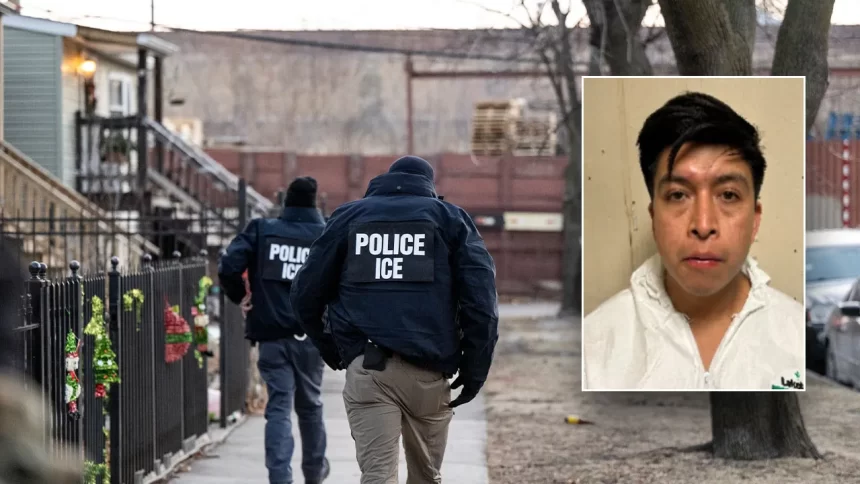
Headline: ICE Arrests Alleged Rapist Amid Sanctuary Law Controversy
In a controversial move on Thursday, U.S. Immigration and Customs Enforcement (ICE) agents arrested an illegal immigrant in New York, who is accused of raping a young girl. The operation took place in spite of the state’s sanctuary laws, designed to protect undocumented immigrants from deportation. The arrest has reignited debates about immigration enforcement practices and the balance between public safety and sanctuary policies.
The man, identified as 34-year-old Juan Carlos Rodriguez, was apprehended in a residential neighborhood in the Bronx. Rodriquez allegedly committed the crime in mid-2022, with authorities stating that he had been living in the country without permission for over a decade. The victim, a minor, reported the incident, prompting a police investigation that ultimately led to the issuance of a warrant for Rodriquez’s arrest.
ICE’s engagement in New York, a self-identified sanctuary state, raises significant legal and ethical questions. New York’s sanctuary laws are crafted to limit cooperation between local law enforcement and federal immigration agents, aimed at protecting immigrant communities from deportation. However, as crimes involving undocumented immigrants become increasingly complicated, law enforcement agencies often find themselves torn between local regulations and federal immigration law.
Local Impact and Community Reactions
Local community members expressed mixed feelings about the arrest. Some residents voiced support for ICE, arguing that public safety must take precedence over immigration status. “We need to protect our children first,” stated a homeowner who wished to remain anonymous. Others, however, fear that such actions can foster distrust within immigrant communities. “This makes people afraid to report crimes,” said Maria Lopez, a local activist advocating for immigrant rights. “It pushes victims further into the shadows.”

Adding to the tension, the Bronx, known for its diverse immigrant population, has historically been a focal point for discussions surrounding sanctuary policies and law enforcement collaboration with federal agencies. Many locals are concerned that this arrest could lead to more aggressive ICE actions, particularly against vulnerable populations.
Legal Framework and Sanctuary Laws
New York’s sanctuary law prohibits local law enforcement from holding individuals for ICE agents unless they have been convicted of a serious crime. In this case, ICE asserted that they were acting within the legal framework, as Rodriguez was wanted for a sexual assault charge—a serious crime that can take precedence under certain state laws.
ICE’s operations are often controversial, with significant public pushback. Critics argue that immigration enforcement should not intrude into local law enforcement matters, and they question the effectiveness of using arrests for serious crimes as justification for broader immigration enforcement actions. In this instance, however, federal agents are defending their methods, claiming that they are protecting victims of violent crimes, regardless of the accused’s immigration status.
The Bigger Picture: Police and Immigration Policy
The intersection of police work and immigration policy continues to pose challenges nationwide. As new administrations come in and out, changes to both immigration enforcement and sanctuary laws create a constantly shifting landscape. Advocates on both sides of the debate argue for different approaches to solving the complexities associated with crime, safety, and immigration status.
The Trump administration notably ramped up ICE operations, making immigrant arrests routine even for individuals without a criminal record. Contrastingly, the Biden administration has called for a more targeted approach, prioritizing violent offenders and allowing states to establish their own sanctuary policies. Yet, arrests like that of Rodriguez illustrate ongoing tensions, with local police departments caught in a tug-of-war between enforcing federal law and protecting community trust.
Impact on Victims of Crime
Notably, the issue affects not just the accused but also the victims of crimes who may feel increasingly vulnerable. Individuals in immigrant communities often hesitate to report crimes, fearing they may be subjected to deportation if they engage with law enforcement. This creates a challenging environment where victims may refrain from seeking justice, consequently leading to further victimization and crime.
“It’s a vicious cycle,” explained Dr. Claudia Mendoza, a social worker who specializes in immigrant trauma. “When people don’t report crimes due to fear, the perpetrators go unpunished, which only emboldens them further.”
Conclusion: Moving Forward
As this case garners media attention and public discourse, it remains to be seen how it will influence local and state policies regarding sanctuary laws and immigrant protections in New York. It underscores the need for a dialogue that weighs public safety against the rights of communities to feel safe from both crime and deportation.
In the coming weeks, advocacy groups on both sides are expected to rally around this case. Pro-immigrant organizations may organize against ICE’s tactics, while those advocating for stricter immigration controls will likely view this as a validation of their approach to law enforcement.
Finding balanced solutions to these complex issues will require cooperation among community leaders, policymakers, and law enforcement agencies. Only time will tell how the discussions surrounding sanctuary policies and public safety will evolve in the wake of this arrest, but as communities confront these difficult issues, it’s clear that dialogue, understanding, and actionable policies will be paramount.