

Jefferson City is Missouri’s capital and one of the most historically significant cities in the American Midwest.
Located along the Missouri River, it has served as the center of state government since the early nineteenth century.
From frontier settlement to modern political hub, Jefferson City’s history reflects Missouri’s complex cultural, economic, and political evolution.
Overview
(STL.News) Jefferson City is the capital of the U.S. state of Missouri and the county seat of Cole County. Located in central Missouri along the southern bank of the Missouri River, it has served as the seat of state government since the early nineteenth century. Although smaller than Missouri’s largest metropolitan centers such as Kansas City and St. Louis, Jefferson City occupies a central place in the state’s political, legal, and institutional history. Its development reflects broader themes in American history, including westward expansion, sectional conflict, Reconstruction, public education, infrastructure growth, and modernization.
Jefferson City’s identity has been shaped primarily by its status as a government center, but its story also includes the influence of Indigenous cultures, European colonization, river commerce, civil rights advancement, and economic transformation.
Geographic Setting and Early Inhabitants
The land that would become Jefferson City lies within the Missouri River valley, an area historically rich in natural resources. The Missouri River provided fertile soil, abundant wildlife, and a major transportation corridor long before the arrival of European settlers.
Indigenous peoples, including the Osage Nation and other Siouan-speaking tribes, inhabited and traveled through the region for centuries. The river served as a trade route and cultural link among tribes across the Midwest. Archaeological evidence indicates long-standing habitation throughout central Missouri.
During the seventeenth and eighteenth centuries, French explorers and traders entered the Missouri River basin. The region became part of French Louisiana before passing to Spanish control in 1762. In 1800, Spain returned the territory to France, and in 1803, the United States acquired it through the Louisiana Purchase. This transaction dramatically altered the political future of the region and opened it to American settlement.
Selection as the State Capital
When Missouri applied for statehood in 1820, political leaders recognized the need for a permanent capital location. The Missouri Compromise admitted Missouri as a slave state in 1821, and the new state legislature sought a site that was centrally located and accessible.
At the time, the area that would become Jefferson City was known as Lohman’s Landing, named after Daniel Morgan Lohman, a local trader who operated a river ferry and store. Its location along the Missouri River made it accessible to settlers traveling by boat, while its central geographic position made it attractive as a political compromise between eastern and western regions of the state.
In 1821, the Missouri General Assembly selected the site as the permanent capital and named it Jefferson City in honor of Thomas Jefferson, whose role in the Louisiana Purchase had made Missouri’s statehood possible. The city was formally incorporated in 1825.
Early Development and the First Capitol
Construction of Missouri’s first state capitol building began shortly after the capital designation. The early structure was modest and functional, reflecting the limited financial resources of the young state. Government operations quickly attracted lawyers, merchants, builders, and tradespeople to the area.
The city’s early economy revolved around government services and river commerce. Steamboats traveling along the Missouri River connected Jefferson City to St. Louis and other regional trade hubs. Businesses developed near the riverfront, and residential areas expanded uphill from the riverbank.
In 1837, the first capitol building was destroyed by fire. A second capitol was constructed but would also face destruction decades later. These setbacks underscored the challenges of frontier construction and the vulnerability of early public buildings.
The Missouri State Penitentiary
In 1836, the Missouri State Penitentiary was established in Jefferson City. Over time, it became one of the oldest operating prisons west of the Mississippi River. The penitentiary housed thousands of inmates and was a major employer within the city.
The prison played a significant role in Jefferson City’s economic and social life. Inmates contributed labor to various state projects, and correctional administration became intertwined with the city’s identity. The penitentiary operated continuously until 2004, after which new correctional facilities replaced it.
Transportation and River Commerce
Throughout the nineteenth century, the Missouri River remained central to Jefferson City’s economic life. Steamboats transported goods, mail, and passengers. Agricultural products from central Missouri flowed downriver to larger markets.
With the rise of railroads in the mid-to-late 1800s, transportation patterns shifted. Rail connections linked Jefferson City more directly to national markets. While river commerce declined relative to rail traffic, the city maintained its strategic importance as a transportation node.
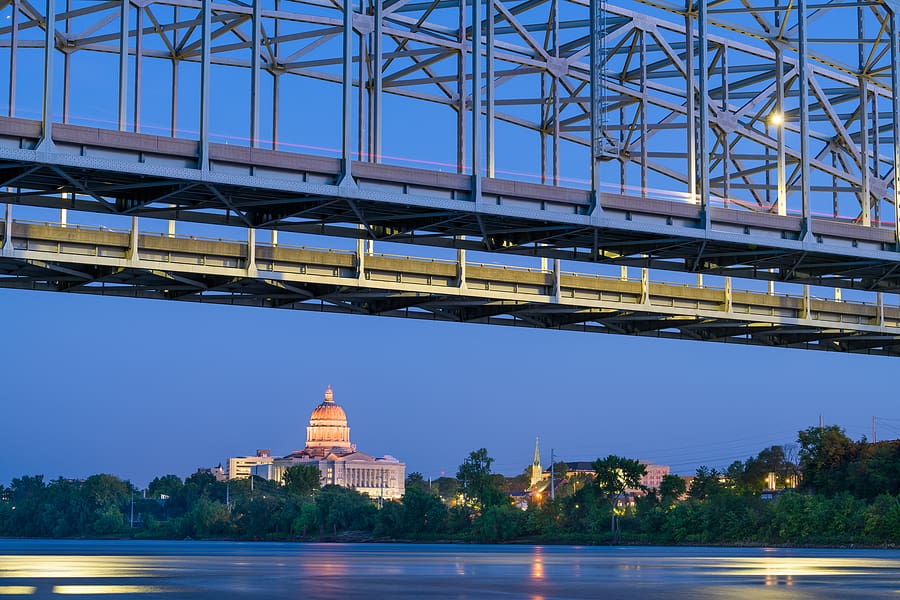
Bridges spanning the Missouri River further enhanced connectivity in the twentieth century, enabling road travel and expanding commercial access.
Civil War and Border State Tensions
Missouri’s position as a border state during the American Civil War created deep internal divisions. Although Missouri remained officially in the Union, it experienced significant Confederate sympathy in various regions.
Jefferson City’s status as the state capital made it a strategic objective. In 1861, Confederate forces under General Sterling Price advanced toward the city. Union troops fortified Jefferson City, and the capital ultimately remained under Union control throughout the war.
The presence of military forces reinforced Jefferson City’s role as a center of state authority. After the war, Missouri underwent Reconstruction, including the abolition of slavery and political realignment.
Founding of Lincoln Institute (Lincoln University)
One of the most significant postwar developments was the founding of Lincoln Institute in 1866. Established by African American veterans of the 62nd and 65th United States Colored Infantry, the school aimed to provide higher education opportunities to formerly enslaved individuals and their descendants.
The institution later became Lincoln University, one of the nation’s historically Black colleges and universities (HBCUs). Its presence shaped Jefferson City’s demographic and cultural composition, fostering educational advancement and civil rights leadership.
Lincoln University contributed to professional training in teaching, agriculture, and public service, reinforcing Jefferson City’s identity as an educational as well as governmental center.
The Second Capitol Fire and Construction of the Current Capitol
In 1911, the second Missouri State Capitol building was destroyed by fire. The loss prompted the state to commission a more substantial and architecturally ambitious structure.
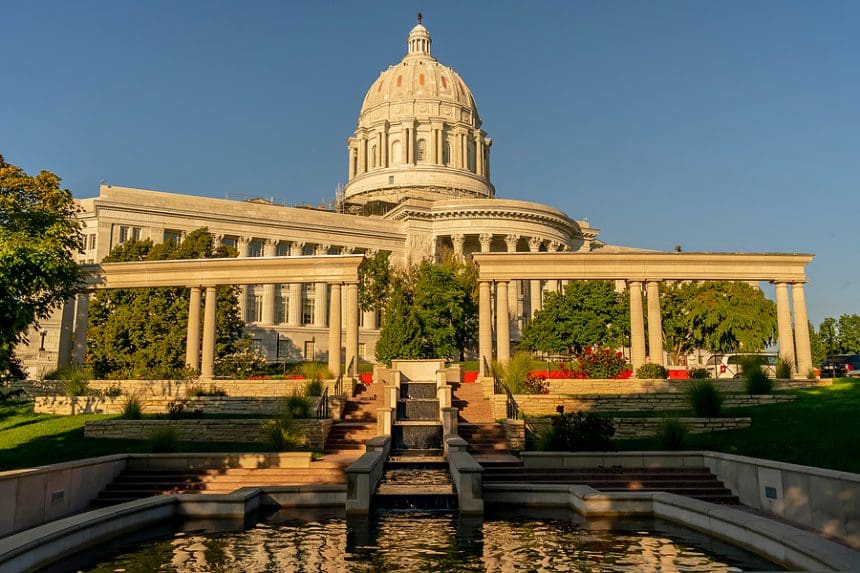
The current Missouri State Capitol was completed in 1917. Designed in the Beaux-Arts architectural style, it features a grand dome rising above the Missouri River. The building houses the offices of the governor, the Missouri General Assembly, and the Missouri Supreme Court.
Murals and artwork within the capitol reflect Missouri’s history, including scenes of westward expansion and civil conflict. The new capitol symbolized the state’s maturation and stability in the early twentieth century.
Twentieth-Century Growth and Stability
Unlike many American cities that experienced industrial booms or declines, Jefferson City’s growth remained relatively steady. Its primary economic driver—state government—provided consistent employment.
During the Great Depression, federal programs supported public works projects in Jefferson City. Infrastructure improvements, road construction, and building expansions strengthened the city’s foundation.
World War II brought broader national economic change, but Jefferson City’s administrative role continued to anchor its economy. Postwar suburban development expanded residential neighborhoods, and modern highways improved regional connectivity.
Flooding and Environmental Challenges
Jefferson City’s location along the Missouri River has brought periodic flooding challenges. Major flood events in the twentieth and early twenty-first centuries tested infrastructure and emergency response systems.
Flood control measures, including levees and river management projects, were implemented to protect downtown and residential areas. These efforts reflect the ongoing balance between natural geography and urban development.
Government and Civic Institutions
As Missouri’s capital, Jefferson City houses key branches of state government. The Missouri General Assembly convenes annually to enact laws. The governor’s office and executive agencies operate from the capitol complex.
The Missouri Supreme Court and other judicial offices are also located in the city. This concentration of political authority has made Jefferson City a focal point for statewide policy debates and legislative decision-making.
The Governor’s Mansion, built in 1871, stands as an official residence and ceremonial site, reinforcing the city’s political identity.
Demographics and Community Life
Jefferson City has historically maintained a moderate population compared to Missouri’s larger cities. German immigrants influenced the region’s architecture and cultural traditions during the nineteenth century.
The presence of Lincoln University contributed to a diverse community and played a role in civil rights advocacy during the twentieth century. Churches, schools, and civic organizations have shaped local social life.
Cultural institutions, museums, and historical societies preserve the city’s heritage. Tourism related to government buildings, historic sites, and riverfront attractions supports local businesses.
Economic Structure
Jefferson City’s economy remains heavily centered on public administration. State government employment continues to dominate. Education, healthcare, retail, and small businesses supplement this foundation.
The closure of the Missouri State Penitentiary in 2004 marked a significant transition. Portions of the historic prison complex have since been repurposed for tours and heritage tourism.
In recent decades, economic development initiatives have sought to diversify the city’s employment base while preserving its governmental character.
Twenty-First Century Developments
In the twenty-first century, Jefferson City has pursued modernization efforts, including downtown revitalization and technological infrastructure improvements. Legislative sessions continue to draw policymakers, lobbyists, journalists, and visitors from across Missouri.
Educational expansion at Lincoln University and investment in community services reflect ongoing adaptation to contemporary needs. While maintaining its historic core, Jefferson City continues to evolve in response to demographic and economic trends.
Historical Significance
Jefferson City’s historical significance derives from its role as Missouri’s enduring capital. From its selection in 1821 to its present function, the city has embodied continuity in state governance.
It has withstood fires, war threats, economic shifts, and environmental challenges. Its institutions—the capitol, Lincoln University, and former penitentiary—represent distinct chapters in Missouri’s broader narrative.
Conclusion
The history of Jefferson City, Missouri, illustrates the development of a state capital rooted in geography, political compromise, and institutional growth. From Indigenous habitation and European colonization to statehood and modernization, the city reflects the layered history of the American Midwest.
As the seat of Missouri’s government for more than two centuries, Jefferson City remains central to the state’s political identity. Its architecture, educational institutions, and civic traditions preserve the legacy of its past while supporting the governance of Missouri in the present.
Other Educational News published on STL.News:
© 2026 St. Louis Media, LLC d.b.a. STL.News. All rights reserved. No content may be copied, republished, distributed, or used in any form without prior written permission. Unauthorized use may result in legal action. Some content may be created with AI assistance and is reviewed by our editorial team. For official updates, visit STL.News.